Skip to content

The latest update from Dunsford Woods from David Price...

Having provided an update for previous visits, I'm now in the situation of "I've started so I'll finish", so with apologies for the fact that this is becoming something of a rather rambling blog I'll carry on inflicting my home-spun observations on you.

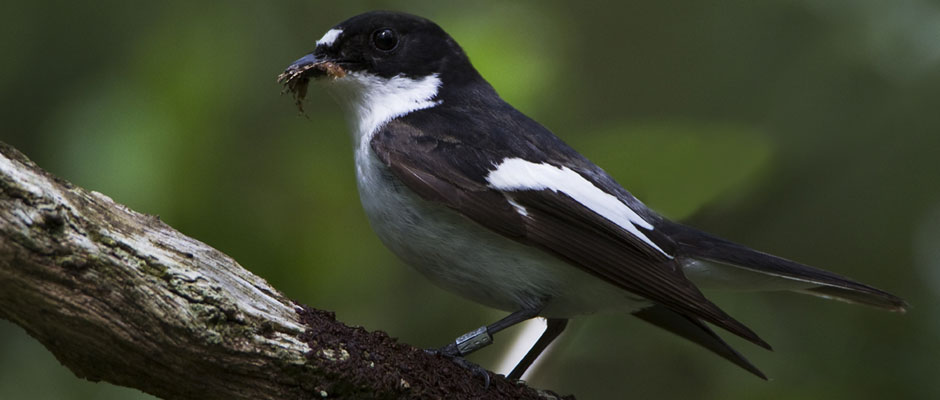
Well, in Box 20, (where the "first Dunsford egg" was laid), three young had hatched yesterday with 4 eggs, still to do so.  In their monograph on the Pied Flycatcher, Lundberg and Alatalo give a range of 13-16 days for incubation so this was just about on cue after 13 days.  On the subject of incubation, I have noticed that in several cases on my previous visit (on 12th May) I recorded typically 6 or 7 eggs that were warm (or perhaps "warmish") so on the basis that incubation had started and I assumed the clutch was complete, only to find yesterday that the clutch size had increased by one or two eggs or in one case from 6 to 9.  I started to doubt my ability to asses warm and cold.  However looking at the chapter in the book on incubation more closely, they mention that the female "actually starts incubation by gradually spending more time on eggs during the laying period" and by the time they get to laying the 5th egg 82% of females will spend the night on the nest, though "full incubation normally begins when the last egg is laid".  It would seem that these "warmish" eggs that caused me confusion are a result of this increasing occupancy of the nest towards the end of laying.  There are several other pairs that are not far behind, and so should be hatching over the next few days - and as I sit here with the fire lit, and the wind and rain beating against the window, (and a rather unsettled weather forecast for the next few days) it's slightly worrying that this is perhaps not going to be great for feeding small young and trying to keep them warm. ...continue reading "Update from Dunsford Woods 18th May"

Funders: Woodland Trust, Heritage Lottery Fund, Natural England

Summary: We know spring temperature plays an important role in determining the timing of breeding of insectivorous woodland birds; invertebrate emergence and abundance is strongly linked to spring temperature. This project has created a fine scale temperature heat-map of East Dartmoor NNR so we can examine this in more detail. We might expect warmer territories to be occupied first, and to initiate breeding earlier. The temperature data has also contributed to a Heritage Lottery Project on Barbastelle bats; the temperature data was combined with radio tracking movement data to look at how temperature influences foraging behaviour.

Please see our paper from this work here: https://doi.org/10.1111/oik.09171

Partners: University of Exeter, University of Edinburgh, British Trust for Ornithology, Ken Smith

Summary: Some animals can adapt to climatic change by altering timing of spring migration or emergence and the onset of breeding. In some species this has been shown to cause a mismatch between consumers (birds) and prey (caterpillars), when phenological changes differ between species. At the scale of Britain we are involved in various analyses investigating spatial variation in caterpillar availability (prey) and bird (predator) breeding parameters in relation to climate and its population consequences.

Partners: University of Exeter, British Trust for Ornithology, University of Groningen, RSPB Centre for Conservation Science, Swiss Ornithological Institute

Funders: Natural England, Devon Birds, British Ornithological Union

Summary: Using the latest advances in technology (geolocators) we are tracking Pied Flycatchers to determine migration timing, routes, strategies, stopover locations and sub-Saharan non-breeding locations. This is addressing fundamental gaps in our knowledge of the species and will guide further research across the flyway. We have discovered that UK breeding Pied Flycatchers spend the northern winter in a relatively small area of western Africa centred on Guinea/Sierra Leone/Liberia. This has led to new work studying Pied Flycatchers, carried out by the RSPB Centre for Conservation Science in partnership with the Liberian BirdLife Partner SCNL and the University of Exeter, in Liberia.